|
|
|
|
| |
|
|
 |
|
 |
|
|
|
|
| |
|
Click here for
pictures of Suakin in 1999 |
|
|
To assist the
Sudanese
local, regional and national authorities in restoring
parts of Suakin,
and consolidating other parts, in order to make the site
more
interesting for visitors and tourists.
Also, to excavate selected earlier structures and
perform a survey of
the
environs, including the bottom of the harbour. A
comparison can be made
with
similar sites further north, including Berenike, Marsa
Nakari and Quseir. |
|
|
|
- September/November
2003 - November/December 2004 - January 2006 |
|
|
|
A small team of scholars affiliated with the McDonald Institute for Archaeological Research in Cambridge, the British Institute for Eastern Africa and the School of Biological and Environmental Sciences of the University of Ulster, co-directed by Michael Mallinson RIBA and Laurence Smith PhD. | |
| Results: | The restoration of one structure, Bayt Khorshid Effendi, was started as were the excavations of the remains of two others: 'Bayt al-Mufti' and 'Bayt al-Pasha'. An initial under-water survey of the harbour was completed, producing several complete glass vessels, whereas a beginning was made with a survey of the hinterland (the 'Geyf'). Full publication of the results is pending (Smith et al. (2012), "Archaeology and the archaeological and historical evidence for the trade of Suakin, Sudan"; in: D.A. Agius, J.P. Cooper, A. Trakadas and C. Zazzaro (eds.). Navigated Spaces, Connected Places: Proceedings of Red Sea Project V, held at the University of Exeter, September 2010, BAR International Series 2346, Oxford (Archaeopress): pp. 173-186). | |
| Approximate position and date of the site: | Suakin is built on
one of
two small islands in a bay of the Red Sea. It is at one
end of a desert
route to the Nile
Valley, ending
at Berber just north of Atbara, which is thought to
predate the Advent
of
Islam. The structures visible
today are obviously of a much
later date. |
|
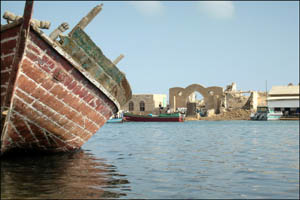
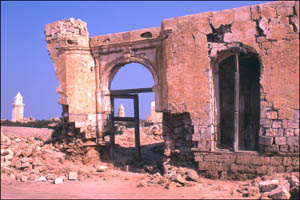
| Short description of the site: | Despite the present dilapidated condition of most of the buildings, the former glory of the town is still evident. Most of the rough surfaces of the coral walls were hidden behind decorated plaster and worked wood. More recent buildings are made to resemble structures built of stone or even concrete. Study of the structures is at the same time hampered and enabled by the fact that little of the debris has been removed to be used elsewhere. The city gate ('Gordon's Gate') and the Hanafy mosque were the last buildings to be restored. Remarkable are the presence of several cannon within the city limits. An earthen wall and several defensive towers have been preserved on the main land. The harbour is still used by three large ferries to Jeddah (and Mecca) as well as by numerous small fishing vessels. | |
| Additional remarks: | My work in Sudan
would
not have been possible without the support of the Fayum
Project and the Cotsen
Institute of
Archaeology at UCLA. |
|
 |
|
 |
| HOME |