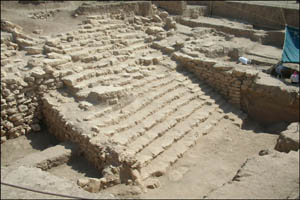
| On the border between the Eurasian steppes and the Anatolian highlands is Tell Mozan (ancient Urkesh) where excavations revealed monumental stone architecture: | Located in modern Syria, near its current borders with Turkey and Iraq, Urkesh was part of the Akkadian Empire and the Mittani Kingdom (ca. 2500-1500 BCE): | |
|
|
|
|
 |
|
 |
|
|
|
|
|
|
To assist with the
on-going excavations, mapping and ceramic analysis at
Tell Mozan
(ancient Urkesh). |
|
|
|
-
August/September
2008 - September 2010 |
|
|
|
Tell Mozan Project staff and team members directed by Marilyn Kelly-Buccellati (Director) Giorgio Buccellati (Co-director) and Federico Buccellati (Field Director). | |
| Results: | |
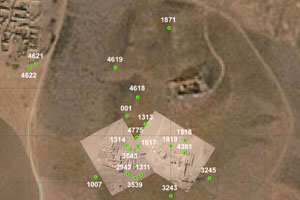
The long-term on-going excavations at Tell Mozan have so far revealed a temple, part of the royal palace, a structure likely used for necromancy and a monumental stairway. My limited involvement in the project entailed the construction of a GIS, mostly aimed at facilitating the establishment of a protected area around the site, and the search for residues of wine in selected potsherds. |
| Approximate position and date of the site: | Tell Mozan is
located
near modern al-Qamishly, in Syria, and Mardin, in
Turkey. The site was
inhabited from approximately 3500-1000 BCE. |
|
| Short description of the site: | Tell Mozan is one of the many city mounds rising above the Eurasian steppes. These are the result of many years of occupation and the large amount of debris and refuse that has accumulated. Upon excavation the site revealed not only mud-brick architecture and many finds, but also rather rare stone structures, including a monumental flight of stairs. The mound is surrounded by scattered ancient remains and has a small modern village near its base. The local climate is continental, with hot summers and cold winters, but also relatively wet springs allowing the cultivation of cereals and cotton. | |
| Additional remarks: | My work in Syria would not have been possible without the Tell Mozan Project and the Cotsen Institute of Archaeology. | |
 |
|
 |
| HOME |