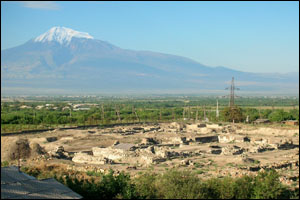
In the shadow of Mount Ararat
(Masis),
where
Noah's Ark is said to have stranded (Gen. 8:4), are
the remains of
Dvin,
the capital of Armenia and See of their Catholicos until
the earthquake of
893 AD:
|
|
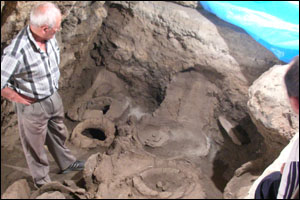
Some distance southeast of Dvin,
in the
highlands north of the Ararat Plain, is Bird
Cave
where several caches
of
ceramic vessels, lithic tools and organic artifacts,
dating 4500-3000
BC, were found:
|
|
|
|
|
|
|
|
|
|
|
|
|
|
Objective of visit:
|
|
To help restart the
archaeological excavation of Dvin and obtain samples of
pottery for
residue analysis. |
|
Date of visit:
|
|
August-September
2007
|
|
Fellow visitors:
|
|
Dr. Gregory
Areshian,
Research Associate of the Cotsen Institute of
Archaeology at UCLA, and
archaeologists of the Armenian Institute of Archaeology
and
Ethnography, co-directed by Aram Kalantaryan and Nyura
Hakobyan. |
| Results: |
|
Three large trenches
were
opened and a small number of samples, both from Dvin and
Bird
Cave,
were taken for future biochemical
analysis (H. Barnard, A.N. Dooley, G. Areshian, B.
Gasparyan, K.F. Faull (2011),
"Chemical evidence for wine production around 4000 BCE
in the Late
Chalcolithic Near Eastern highlands," Journal
of Archaeological Science 38:
pp. 977-984).
|
| Approximate
position and
date of the site: |
|
Dvin is located
about 40
km. southeast of Yerevan, the modern capital of
Armenia. The city
was founded in 330-338 AD, on top of an ancient
settlement, by Khosrov
II, to replace the previous capital at Artaxata. After Armenia was
conquered in 428 AD,
Dvin became the residence of the
Sassanid, Byzantine, Umayyad and Abbasid governors.
Despite the fact
that the city was repeatedly conquered by nearby
Christian and
Islamic empires, and saw several Armenian uprisings, it
remained a
prosperous economic and cultural center. Major
earthquakes in 863 and
893 AD all but destroyed the city and killed many of its
100,000
inhabitants. Although the city was eventually rebuilt,
the move of the Catholicos (patriarch
of the Armenian
monophysite Christian church) to Echmiadzin (in
Vagharshapat)
combined with the changing geopolitical situation in the
region made
that it never regained its
former splendor. Dvin was finally destroyed by Mongol
invaders in 1236.
|
| Short description
of the
site: |
|
Dvin is standing
above a
fertile agricultural plain with abundant orchards,
vineyards and
vegetable gardens. The highest part of the site is
formed by the
remains of the citadel, surrounded by mud-brick
defensive walls and a
moat. Southwest of this are the remains of a large
cathedral (30 x 58
m.) dedicated to Saint Gregory the Illuminator, built on
an earlier
pagan temple. Surrounding this are the remains of the
palace of
the Catholicos,
built in the
7th century AD. Large parts of the former city are now
under the modern
agricultural fields and settlements in the area.
Archaeological
investigations of Dvin have been going on since 1937,
albeit
interrupted
from time to time for political or financial reasons.
Isolated finds
indicate that the history of the site does go back as
far as the 3rd
millennium BC (Bronze Age), contemporary with the use of
Bird
Cave.
|
| Additional remarks: |
|
My work in Armenia
would
not have been
possible without the Cotsen
Institute of Archaeology and Pavel Avetsyan,
Director of the
Armenian Institute of Archaeology and Ethnography.
|
 |
|
|
| HOME |
|
|
